In short
- Vehicle transport moves your car or van on a truck — you do not drive it anywhere.
- For an accurate price, the operator needs both locations, the vehicle, and whether it runs, rolls and steers.
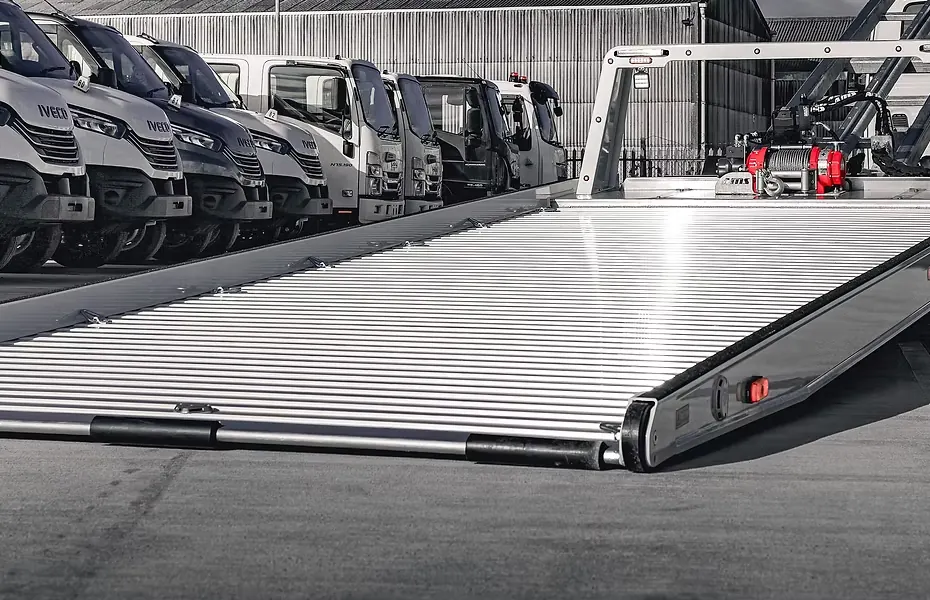
- Runners are driven onto a tilted bed; non-runners are winched on and secured.
- The price depends mainly on distance, vehicle size, condition, access and timing.
- Agree the full price upfront, before the truck sets off.
1. When to transport a vehicle instead of driving it
Transport is the right answer whenever driving the vehicle is impractical, impossible or unwise:
- You have bought or sold a vehicle some distance away, and it needs to change hands without being driven.
- The vehicle is not road-ready — no MOT, tax or insurance, a known fault, or it has been off the road.
- It is going to a workshop, restorer or specialist and should not be driven in its current state.
- You are relocating — moving home, moving a second car, or moving vehicles between depots and storage.
- It is a project, classic or purchase you want to protect from a long unfamiliar drive.
Dealers and fleets use the same service for stock movements and depot transfers. Our vehicle transport service covers cars and vans, runners and non-runners, anywhere in the UK.
2. What the operator needs to give you a price
An accurate quote takes two minutes if you have the right details ready:
- Collection and delivery locations — postcodes where you have them.
- The vehicle — make, model and registration.
- Its condition — does it start and drive? Does it roll freely? Does the steering work?
- Keys — are they with the vehicle?
- Access — anything tight, steep, gated or time-restricted at either end.
- Timing — your preferred date, and any deadline.
The condition answers matter most. A runner that drives onto the bed and a non-runner with locked steering are two very different jobs, and honest details mean no surprises on the day.
3. How vehicle transport works, step by step
- The job is agreed. Locations, vehicle, condition, destination, timing and the full price are confirmed upfront.
- The truck arrives and the bed is lowered. A 7.5-tonne tilt-and-slide bed slides back and tilts to a shallow, low loading angle.
- The vehicle is loaded. Runners can be driven on; non-runners are pulled on smoothly with a 10,000 lb hydraulic winch.
- It is secured. The vehicle is lashed using D-ring anchor points and wheel chocks for the journey.
- It travels insured. Your vehicle is covered by goods in transit and on-hook insurance while it is carried.
- It is unloaded at the destination — home, garage, dealer, workshop or storage, as agreed.
4. What affects the cost of vehicle transport?
There is no honest fixed price list for transport, because the jobs differ. Quotes are normally based on:
- Distance — the round trip the truck has to make, not just the delivery mileage.
- Vehicle size and type — a small hatchback and a large van load and carry differently.
- Condition — winching a non-runner with steering problems takes longer than driving a runner on.
- Access at both ends — tight streets, car parks, slopes and restricted sites all add time.
- Timing — how urgent it is and when it needs to happen.
- Two vehicles together — where suitable, moving two vehicles on one journey can be better value than two separate trips. See two-vehicle transport.
Whatever operator you use, agree the full price before the truck rolls and confirm there is nothing extra to pay on top.
5. How to prepare your vehicle for transport
- Clear access so the truck can position and the bed can lower.
- Have the keys ready — including any separate immobiliser fob — or tell us if there are none.
- Remove valuables and personal items you do not want travelling with the vehicle.
- Photograph the vehicle before collection. It gives you and the operator the same record of its condition.
- Mention the quirks — a flat battery, a sticky handbrake, an alarm that goes off, a steering lock. Small details save time on the day.
6. Non-runners, no keys and locked steering
A vehicle does not need to run to be transported. Winch loading is designed for non-runners, including vehicles bought as projects and accident-damaged vehicles. What changes the job is how the vehicle moves: whether it rolls, whether the steering turns, and whether the wheels are intact. Locked steering or damaged wheels simply need to be planned for, which is why condition is the first question a good operator asks. If the vehicle cannot roll or steer at all, say so — it is rarely a problem, but it should never be a surprise.
7. Questions to ask any transport operator
- Is that the full price, agreed before you set off?
- Can you load a non-runner, and one that will not steer?
- Is my vehicle insured while it is on your truck?
- How will the handover work at each end?
- Who do I call for an update on the day?
Common questions
Can you transport a car with no MOT, tax or insurance?
Yes. The vehicle travels secured on the truck bed rather than being driven on the road, so transport is the standard way to move a vehicle that is not currently road-legal. Tell us its condition when you book.
Can you move a non-runner?
Yes. Non-runners are loaded using the hydraulic winch. Tell us whether the vehicle rolls and steers, and whether you have the keys, so loading can be planned properly.
Can you move two vehicles at once?
Where suitable, yes — SK Recovery offers two-vehicle transport, with one vehicle on the bed and one on the spec lift. Mention both vehicles when you ask for a price.
How far will you travel?
Across the UK. SK Recovery is based in London and provides vehicle transport nationwide.
Is my vehicle insured during transport?
Yes. Every load is covered by goods in transit and on-hook insurance from when the vehicle is secured until it is unloaded.
Do I need to be there for collection and delivery?
Not always. Handover arrangements can be agreed when you book — for example with a garage, dealer or another contact — but make sure the operator knows exactly who is releasing and receiving the vehicle.
Ready to move a vehicle?
Call 07944 597463 for urgent transport, or request a quote for a planned move and we will reply with a price. Broken down instead? Read our breakdown recovery guide.